


LEGION REPORTS
Department Membership Summary
Post Membership Summary

Washington, D.C. — U.S. Senators Marco Rubio (R-FL) and Kirsten Gillibrand (D-NY) introduced the bipartisan and bicameral Presumptive Benefits for War Fighters Exposed to Burn Pits and Other Toxins Act. U.S. Representatives Raul Ruiz, M.D (D-CA) and Brian Fitzpatrick (R-PA) will introduce the legislation in the U.S. House of Representatives. This bill would provide presumptive U.S. Department of Veterans Affairs benefits to servicemembers who have deployed and have illnesses due to exposure to burn pits and other toxins. Approximately 3.5 million veterans have been exposed to burn pits that spewed toxic fumes and carcinogens into the air.
Rubio, Gillibrand, and Ruiz also announced an April 13, 2021 press conference outside of the U.S. Capitol that will feature veterans who have suffered from toxic exposure, survivors of veterans who have passed due to toxic exposure, veterans advocate Jon Stewart, 9/11 activist John Feal, Burn Pits 360, the IAVA, American Legion, and several other veterans groups.
“Our war fighters had a job to do, and they did it honorably and without hesitation,” Rubio said. “We will never be able to repay them and their families for their sacrifice, but we can — and we must — take care of them now. This historic and long overdue legislation will cut through the red tape to ensure veterans exposed to burn pits and other toxins while defending our nation will receive the care they need and deserve. No more excuses. No more delays. It is time to act.”
“More than three million service members could have been exposed to toxic burn pits, yet the VA continues to deny them care by placing the burden of proof on veterans suffering from rare cancers, lung diseases, and respiratory illnesses,” Gillibrand said. “Congress cannot sit by as the VA ignores its duty. The bottom line is that our veterans served our country, they are sick and they need health care—period. The Presumptive Benefits for War Fighters Exposed to Burn Pits and Other Toxins Act will finally establish a presumptive service connection for veterans exposed to burn pits and other toxins and streamline the process for obtaining vital VA benefits. I am proud to cosponsor this bipartisan legislation with Senator Rubio, and I thank Congressman Ruiz for his leadership in the House. I urge my colleagues on both sides of the aisle to support this bill and to apply common sense and common decency to a broken process.”
“Our veterans cannot wait. Service members are returning home from the battlefield only to become delayed casualties of war, dying years later from lung diseases, cancers, and autoimmune diseases caused by their exposure to toxic military burn pits,” Ruiz said. “The VA and DoD cannot continue to neglect this self-inflicted wound on our veterans. That’s why I co-authored the Presumptive Benefits for War Fighters Exposed to Burn Pits and Other Toxins Act with Senator Gillibrand to get our veterans the care they need right now.”
“Our veterans are heroes and deserve to be treated as such, yet the VA and DoD continue to deny their earned care,” Fitzpatrick said. “Our bipartisan Presumptive Benefits for War Fighters Exposed to Burn Pits and Other Toxins Act will establish a presumptive service connection for veterans exposed to burn pits and other toxins and streamline the process for obtaining vital VA benefits. I am proud to join Rep. Ruiz and Senator Gillibrand and a broad national coalition of VSOs to ensure our veterans receive the care they deserve. No veteran should die waiting for care.”
“This legislation includes presumption and actually fixes this urgent and immoral issue. Anything else just delays and denies the treatment and benefits our warriors need,” said veterans advocate Jon Stewart.
“If we can spend money on training ordinary men & woman to go into combat and do extraordinary things keeping us safe 24/7, then we should be able to spend money when these Heroes come home missing body parts, have a mental illness or are poisoned by the toxic aftermath from Burn Pits. We are fighting two fronts. Passing vital legislation, and changing the culture on how these men & woman are taken care of after they come home,” said 9/11 Responder & Advocate John Feal.
“Our families are calling on Congress to pass the Warfighter Presumption Bill. Your constituents, veterans and their families should not have to return from war to face the injustice of the denial of compensation and health care benefits–we will not settle for less than presumption. Together with veteran owned businesses, veteran organizations, Veteran Public Figures, police and firefighter unions and the rest of America we will mobilize a national movement to pass this legislation. We are not fulfilling our moral obligation to protect and serve these service men and women that bore the burden of America’s defense. We must take action to chip away at the complex web of barriers, erected by entrenched political and bureaucratic interests, which deprive a class of injured veterans of healthcare and benefits. It’s time we recognize these injuries as a true cost of war,” said Rosie Torres, Executive Director of Burn Pits 360
“This legislation regarding Burn Pit exposure is required to fulfill our sacred obligation to the men and women who faithfully served,” said David Shulkin M.D., ninth secretary of the U.S. Department of Veteran Affairs.
“For IAVA members, the data is clear: 86% of members have been exposed to burn pits or other toxic exposures, and 88% either have or may already have symptoms from that exposure. It is past time that veterans exposed to these deadly toxins receive the benefits that they deserve. We thank Senator Kirsten Gillibrand and Representative Raul Ruiz for their important leadership to ensure that veterans exposed to burn pits and other toxic exposures will be able to get a presumption of illness for that exposure,” said Jeremy Butler, CEO of Iraq and Afghanistan Veterans of America (IAVA).
“We look forward to Congress reintroducing and passing the Presumptive Benefits for War Fighters Exposed to Burn Pits and Other Toxins Act. Congress must act now to ensure that veterans exposed to toxic exposures receive the care that they need and rightfully deserve. We thank Senator Kirsten Gillibrand, Senator Marco Rubio, Representative Raul Ruiz for their leadership on this issue and look forward to working with them to get this critical legislation passed by Congress and signed by the President,” said National Commander James W. Bill Oxford, American Legion.
“As Vietnam veterans, we know firsthand the toll of toxic exposure on our health and the high costs associated with our toxic wounds. Times is of the essence, and we call for swift passage of this crucial legislation with the hopes that our younger veterans will not face the decades-long fight for healthcare and benefits that continues to plague Vietnam veterans,” said VVA National President John Rowan.
“To do justice to Vietnam and 1991 Gulf War veterans suffering from the effects of Agent Orange and Gulf War Illness, Congress had to legislate presumptions. It is past time to create a similar presumption for the sick veterans of our Nation’s more recent wars and military operations in countries having toxic environments created by burn pits or other conditions — natural or man-made,” said Peter Sullivan of SGT Sullivan Circle.
“Many of our veterans who served in Iraq, Afghanistan and other countries are suffering from the toxic exposures from burn pits. It took the Vietnam Veterans years to fight for their benefits from exposure to Agent Orange and other toxic herbicides. In fact, we are still fighting for those who served in Guam, Panama, Thailand, and Okinawa. Vietnam veterans pushed not only for these benefits from their personal exposures to toxins, but for those suffering from PTSD as well. Let us not forget these young warriors, who are also suffering from the toxins released from the Burn Pits and in some cases radiation poisoning. No one wants to see these men and women wait decades for their earned and deserved benefits. Action is needed ASAP. Members from our organization, Military Veterans Advocacy will leave no service member or veteran behind. When these brave heroes raised their hands in an oath to defend this nation at all costs including their lives, our country promised to care for then when they returned. This country needs to be made accountable in keeping that promise. This is part of the pricetag of war,” said Susie Belanger, Legislative Director, Military Veterans Advocacy, Inc.
“We applaud Sen. Gillibrand, Sen. Rubio, Rep. Ruiz, and Rep. Fitzpatrick for their commitment to servicemembers and veterans who have been dying and suffering from the devastating illnesses as a result of their exposure to toxic emissions from burn pits. This legislation does for victims of toxic exposures and burn pits what the Agent Orange Act did for veterans who were exposed to Agent Orange in Vietnam. This presumption of exposure and service connection is long overdue for veterans who were exposed to toxic emissions,” said National Veterans Legal Services Program Executive Director Bart Stichman.
“Too often, veterans have been alone in dealing with the consequences of service to their country. This is now an opportunity to stand with them, to honor their commitment, and together confront the challenges they are facing from exposure to burn pits and other toxins during their military service,” said COL Sam Whitehurst, Vice President, Programs & Services, Dixon Center for Military and Veterans Services.
“For many veterans with toxic exposures, there has been — for them — a clear timeline connecting their toxic exposures during their military deployments to the debilitating health outcomes that followed them home. Far too many veterans who were exposed to open burn pits and a veritable toxic soup have developed terrible respiratory conditions, Parkinson’s and other diseases, and cancers, including the brain cancer that has taken so many of their lives. This critically important legislation will provide the missing link to help these veterans. Indeed, this is the only current, major toxic exposure legislation to actually name presumptive conditions for VA disability claims rather than lay out a bureaucratic process that relies on trusting VA to do the right thing — the same VA that currently denies Gulf War and Burn Pits-related claims at 80 percent denial rates. In this year of the 30th anniversary of the beginning of the Gulf War (Operation Desert Storm), we are deeply grateful to Senator Gillibrand and the many powerful cosponsors for ensuring this legislation will help so many veterans who served, including Gulf War, other pre-9/11, and post-9/11 veterans alike,” said Anthony Hardie, National Chair & Director Veterans for Common Sense.
“At VoteVets, we believe caring for our men and women in uniform — both during and after their service — is a national security priority, and it is essential to keep our sacred promise to those who’ve fought for our freedoms. Veterans and military families are suffering severe health consequences as a direct result of toxic exposure to burn pits. We’re grateful to Senator Gillibrand and her colleagues for their leadership on this critical issue. Our heroes deserve the comprehensive solution this bill will provide,” said Mary Kaszynski, Director of Government Relations for VoteVets.
“The Stronghold Freedom Foundation is grateful for Senator Gillibrand’s proposed Presumptive Benefits for War Fighter Exposed to Burn Pits and Other Toxins Act. Upon passage, this legislation will provide some respite for Karshi-Khanabad Airbase (K2) veterans denied the care and benefits earned through their service and will greatly benefit many more. The Stronghold Freedom Foundation will continue to advocate for full recognition by the government and agencies which placed K2 veterans in harm’s way and will continue working with legislators, the DoD, and VA to obtain complete recognition, preventative care, screening, and registry for all K2 veterans,” said The Stronghold Freedom Foundation.
During military operations in the Global War on Terror and the Gulf War, the military employed open-air burn pits in order to burn garbage, medical waste, plastics, and other waste from military installations. According to estimates, at least 230 pits were utilized in Iraq and Afghanistan, and many others were used across the world. The largest of these burn pits were located at Balad Air Base, Iraq, and during its operation, was comprised of 10-acres of burning trash, 24-hours a day, 365 days a year.
It has long been established that burning waste and garbage has significant negative impacts on the environment and human health–which is why using burn pits on American soil is against the law and exposure to other toxic substances is highly regulated. However, the military exposed millions of our men and women in uniform to carcinogenic toxic fumes released by burn pits that were used throughout the Middle East, North Africa, and Southwest Asia. It is estimated that more than 3.5 million military personnel could have been exposed to burn pits and the VA’s Airborne Hazards and Open Burn Pit Registry website shows that nearly 235,00 veterans and service members have completed and submitted a questionnaire to self-report medical information about burn pit exposure.
Furthermore, the exposure of our service members to dangerous chemicals and environments has not been limited to burn pits. Shortly after 9/11, the U.S. military established Camp Stronghold at the Karshi-Khanabad Air Base, known as K2, a former Soviet base in Uzbekistan that had held chemical weapons enriched with Uranium. Thousands of veterans were exposed to these dangerous toxins at this base, and many now suffer from rare cancers and other ailments.
Veterans are now sick and dying from lung diseases, cancers, and respiratory illnesses after living among this toxic cocktail of dust, smoke and debris while serving our country overseas. However, the Department of Veterans Affairs continues to deny many veterans access to the VA with the excuse that there isn’t enough science to prove their ailments are service-connected.
Under current law, a veteran who has an illness or disability must establish a direct service connection in order to be eligible for VA benefits. Direct service connections means that evidence establishes that a particular injury or disease resulting in a disability was incurred while in service in the Armed Forces. For veterans exposed to burn pits, this means they would need to provide medical evidence of a current disease or disability, provide personal or other evidence of in-service physical presence near a specific burn pit or exposure to specific toxins or substance and provide evidence of a link between the disability or illness and exposure. Upon completion of these steps, the VA determines if there is enough evidence to provide a medical exam and continue with the disability compensation claim. Therefore, it is currently the veteran’s responsibility to provide their illness or disability is directly connected to burn pit exposure.
The Presumptive Benefits for War Fighters Exposed to Burn Pits and Other Toxins Act would remove the “burden of proof” from the veteran to provide enough evidence to establish a direct service connection between their health condition and exposure. Rather, the veteran would only need to submit documentation that they received a campaign medal associated with the Global War on Terror or the Gulf War and they suffer from a qualifying health condition. Campaign medals are awarded to members of the armed forces who deploy for military operations in a designated combat zone or geographical theater.
Presumptive conditions include a wide range of cancers and respiratory illnesses, including: asthma, that was diagnosed after service, head cancer of any type, neck cancer of any type, respiratory cancer of any type, gastrointestinal cancer of any type, reproductive cancer of any type, lymphoma cancer of any type, lymphomatic cancer of any type, kidney cancer, brain cancer, melanoma, chronic bronchitis, chronic obstructive pulmonary disease, constrictive bronchiolitis or obliterative bronchiolitis, emphysema, granulomatous disease, interstitial lung disease, pleuritis, pulmonary fibrosis, sarcoidosis.
The following organizations support the bill: Vietnam Veterans of America, Iraq and Afghanistan Veterans of America, The American Legion, Burn Pits 360, Vote Vets, Military Veterans Advocacy, Stronghold Freedom Foundation, Dixon Center, Veterans for Common Sense, Sergeant Sullivan Circle, National Veterans Legal Services Program, Warriors Project, Grunt Style, Feal Good Foundation.
VIETNAM WAR VETERANS DAY IN FLORIDA
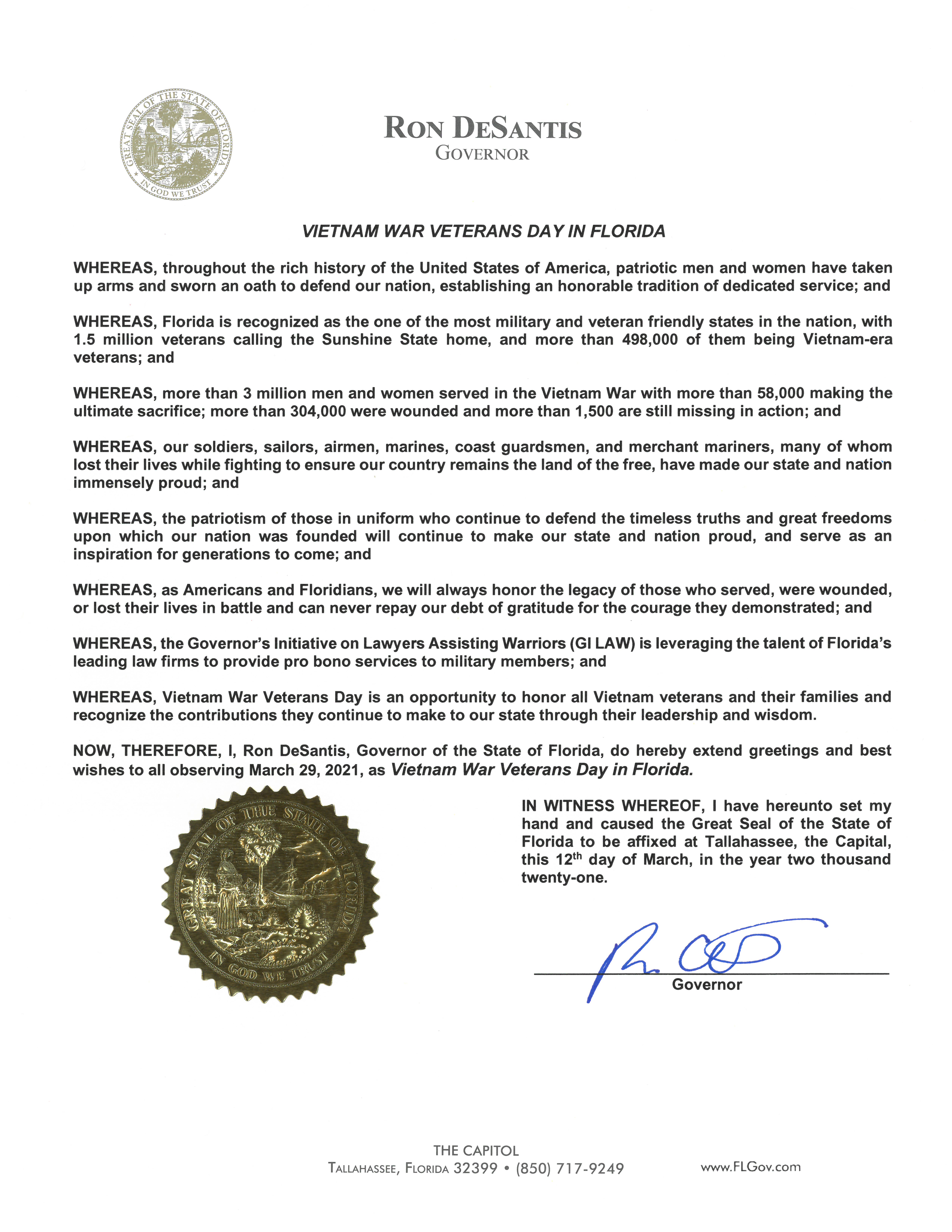 WHEREAS, throughout the rich history of the United States of America, patriotic men and women have taken up arms and sworn an oath to defend our nation, establishing an honorable tradition of dedicated service; and
WHEREAS, Florida is recognized as the one of the most military and veteran friendly states in the nation, with 1.5 million veterans calling the Sunshine State home, and more than 498,000 of them being Vietnam-era veterans; and
WHEREAS, more than 3 million men and women served in the Vietnam War with more than 58,000 making the ultimate sacrifice; more than 304,000 were wounded and more than 1,500 are still missing in action; and
WHEREAS, our soldiers, sailors, airmen, marines, coast guardsmen, and merchant mariners, many of whom lost their lives while fighting to ensure our country remains the land of the free, have made our state and nation immensely proud; and
WHEREAS, the patriotism of those in uniform who continue to defend the timeless truths and great freedoms upon which our nation was founded will continue to make our state and nation proud, and serve as an inspiration for generations to come; and
WHEREAS, as Americans and Floridians, we will always honor the legacy of those who served, were wounded, or lost their lives in battle and can never repay our debt of gratitude for the courage they demonstrated; and
WHEREAS, the Governor’s Initiative on Lawyers Assisting Warriors (GI LAW) is leveraging the talent of Florida’s leading law firms to provide pro bono services to military members; and
WHEREAS, Vietnam War Veterans Day is an opportunity to honor all Vietnam veterans and their families and recognize the contributions they continue to make to our state through their leadership and wisdom.
NOW, THEREFORE, I, Ron Desantis, Governor of the State of Florida, do hereby extend greetings and best wishes to all observing March 29, 2021, as Vietnam War Veterans Day in Florida.
SAVE LIVES Act allows VA to soon provide COVID-19 vaccinations to all Veterans, their spouses and caregivers
WASHINGTON — President Joe Biden signed the SAVE LIVES Act into law today, expanding VA’s legal authority to provide COVID-19 vaccines to all Veterans, regardless of their VA health care enrollment status, as well as Veteran spouses, caregivers and some beneficiaries.
The SAVE LIVES Act removed some of the legal limits on the medical care VA can provide to Veterans, based on health care eligibility and priority groups.
The expanded authority depends on readily available COVID-19 vaccine supply and requires VA to continue to prioritize vaccinations and healthcare delivery for our nation’s Veterans enrolled in VA care.
“The SAVE LIVES Act increases the number of individuals who are eligible to get lifesaving COVID-19 vaccines from VA from 9.5 million to more than 33 million,” said VA Secretary Denis McDonough. “Meeting the task of vaccinating this expanded population will be a tremendous undertaking for the VA and will require a significant increase in our allocation of vaccine supply, but I am confident that VA’s workforce is up to the task.”
VA is providing COVID-19 vaccinations to Veterans and employees per its COVID-19 Vaccination Plan. As of March 24, VA has fully vaccinated 1,594,812 individuals, including Veterans, VA employees and federal partners.
The next steps in VA’s prioritized expansion efforts are to offer the vaccine to all enrolled Veterans – approximately 9.5 million – followed by those outlined in the bill, as vaccine supply permits:
In March and April 2021, VA will conduct pilots of COVID-19 vaccination for individuals specified in HR1276 at select VA medical centers. These pilots will work through critical steps in the process including communications, operations including space and staffing, systems for registration, enrollment, and scheduling, documentation, and data transmission.
VA currently receives approximately 200,000 first, or single doses, of COVID-19 vaccine each week. VA estimates that it will need a minimum of 300,000 first or single doses of COVID-19 vaccine weekly to offer COVID-19 vaccination to an additional three million Veterans who are enrolled but not currently using VA health care. VA estimates that it will need approximately 600,000 first, or single doses, of COVID-19 vaccine each week to further expand vaccination to all individuals outlined in HR1276. First or single dose supply is the best indicator of VA’s capacity to offer expanded COVID-19 vaccination.
Interested Veterans, their caregivers and Veteran spouses who qualify under the legislation can click here to get more information about COVID-19 vaccines at VA. Updates will be provided regarding the availability of vaccine supply and other resources.
NATIONAL EXCUTIVE COMMITTEE
OF
THE AMERICAN LEGION
INDIANAPOLIS, INDIANA
MAY 4 – 5, 2016
Resolution No. 21: Reiteration of 1960 National Executive Committee to Urge Departments to Restrict Resolutions to Matters Relevant to Purposes for Which The American Legion was Organized
Origin: Internal Affairs Commission
Submitted By: Internal Affairs Commission
WHEREAS, One of the major objectives of The American Legion is the enactment of its national legislative program; and
WHEREAS, Each year the National Convention committees are required to give consideration to numerous resolutions referred to them, through channels, as the result of action taken at department conventions in adopting resolutions calling for the enactment by Congress of legislation concerning matters which are far afield of the main objectives for which The American Legion was organized, namely Rehabilitation, Child Welfare, National Security and Americanism; and
WHEREAS, It has become necessary to remind the departments, a main source for all resolutions, that the national organization operates through commissions and their subordinate committees established by the National By-laws of Article I, Section 6; and
WHEREAS, Such commissions and their subordinate committees should forthwith discontinue their present policy of considering resolutions submitted by private organizations to further their own interests by submitting to departments resolutions calling for legislative action by Congress and urging their adoption by the delegates to our National Convention; now, therefore, be it
RESOLVED, By the National Executive Committee of The American Legion in regular meeting assembled at Indianapolis, Indiana, on May 4-5, 2016, That the national adjutant be, and he hereby is empowered and directed to send a copy of this resolution, together with an appropriate covering letter no later than September 15th of each year, to all department commanders, department adjutants, National Executive Committeemen, the chairmen of all national commissions and committees, the directors of all commissions, and the chairmen of all National Convention committees, with the directive that every reasonable effort be made to reject resolutions which are far a field of the main objectives for which The American Legion was organized which are today known as “The Four Pillars” at the department level; and, be it further
RESOLVED, That the National Executive Committee hereby requests that all of the departments, through their department commanders, department adjutants and National Executive Committeemen, bring this situation to the attention of the delegates assembled at their annual department conventions; and, be it further
RESOLVED, That the National Executive Committee hereby requests that all resolutions calling for consideration by the National Executive Committee or the National Convention of The American Legion, be supported by the identification of the individual or group originating the resolution, and also by a written statement or brief containing the support arguments in favor of the action sought, and clearly establishing the material relevance of the subject to the purposes for which The American Legion was formed; and, be it finally
RESOLVED, That Resolution No. 21, adopted May 4-5, 1960, is hereby rescinded.
Bass Pro Shop in Orlando is holding an open house on Wednesday, April 1, 2021 from noon until 6:00pm.
Now hiring excited and motivated outfitters nationwide, view opportunities at basspro.com/careers.
The president of the United States has issued a proclamation for display of the United States flag at half-staff until sunset on March 27, 2021, as a mark of respect for the victims of the senseless act of violence perpetrated on March 22, 2021, in Boulder, Colo. White House proclamations are available at https://www.whitehouse.gov/presidential-actions/
The Orlando VA Healthcare Center is offering COVID-19 vaccines for all Veterans who receive care at VA regardless of age at certain VA clinics (see below for details). The vaccine is being offered at five sites of care this week through a combination of appointments and walk-ins until supply is exhausted. Location specific information:
Veterans must be enrolled and eligible for VA health care benefits. Veterans must be able to return to clinic they received their first shot at for a second dose.
Veterans will receive either the Pfizer, Moderna or Janssen vaccine at no cost.
To schedule an appointment call 407.631.0499 (Available Monday- Friday from 7:30 a.m.- 4 p.m.)
Veterans who are not enrolled or do not currently receive care at VA can visit VA’s Eligibility web page to learn more: Eligibility For VA Health Care | Veterans Affairs.
For information contact the Orlando VA Healthcare System’s Public Affairs Office at vhaorlpublicaffairs@va.gov
WASHINGTON (March 1, 2021) – The nation’s largest veteran service organization, The American Legion, is pushing to strengthen military naturalization programs in support of non-citizens who honorably serve, for at least a year, in the U.S. Armed Forces.
On behalf of its nearly two million members, the organization sent a letter to President Joe Biden requesting an executive order authorizing the reinstitution of the U.S. Citizenship and Immigration Services (USCIS) for Naturalization at Basic Training Initiative and reopening all USCIS field offices abroad for servicemembers and deported veterans.
“The American Legion believes that non-citizen veterans who are honorably discharged and have not been charged or convicted with felonious or heinous crimes should be guaranteed the promise they were made of citizenship,” said James W. “Bill” Oxford, national commander of The American Legion. “We would like to see the reinstitution of the USCIS Naturalization at Basic Training Initiative to provide onsite immigration resources and staff to support recruits beginning the naturalization process.”
The American Legion also recommends requiring the Department of Veterans Affairs assess the barriers to care and benefits that deported veterans face. “Our appeal is for President Biden to remove the barriers to VA benefits which these veterans have earned through their service to this country. These veterans took an oath to defend the United States with their lives. Awarding them with citizenship is the right thing to do,” said Oxford.
Through two organizational resolutions, The American Legion supports the implementation of measures to ensure the process of naturalization is complete prior to discharge for those who have served honorably. In addition, the organization calls on the federal government to grant expedited citizenship applications to deported veterans who were honorably discharged and have no felony convictions.
WASHINGTON (March 1, 2021) – The nation’s largest veteran service organization, The American Legion, is pushing to strengthen military naturalization programs in support of non-citizens who honorably serve, for at least a year, in the U.S. Armed Forces.
On behalf of its nearly two million members, the organization sent a letter to President Joe Biden requesting an executive order authorizing the reinstitution of the U.S. Citizenship and Immigration Services (USCIS) for Naturalization at Basic Training Initiative and reopening all USCIS field offices abroad for servicemembers and deported veterans.
“The American Legion believes that non-citizen veterans who are honorably discharged and have not been charged or convicted with felonious or heinous crimes should be guaranteed the promise they were made of citizenship,” said James W. “Bill” Oxford, national commander of The American Legion. “We would like to see the reinstitution of the USCIS Naturalization at Basic Training Initiative to provide onsite immigration resources and staff to support recruits beginning the naturalization process.”
The American Legion also recommends requiring the Department of Veterans Affairs assess the barriers to care and benefits that deported veterans face. “Our appeal is for President Biden to remove the barriers to VA benefits which these veterans have earned through their service to this country. These veterans took an oath to defend the United States with their lives. Awarding them with citizenship is the right thing to do,” said Oxford.
Through two organizational resolutions, The American Legion supports the implementation of measures to ensure the process of naturalization is complete prior to discharge for those who have served honorably. In addition, the organization calls on the federal government to grant expedited citizenship applications to deported veterans who were honorably discharged and have no felony convictions.
(INDIANAPOLIS, February 25, 2021) – Alarmed by a report that 35 state veterans homes across the country have not shared coronavirus data with the Department of Veterans Affairs, the head of the nation’s largest veterans organization called on the facilities to “obey the law.”
“A federal law requires VA to post information about coronavirus cases and deaths that occur at state-run veteran homes,” National Commander of The American Legion James W. “Bill” Oxford explained. “Stars & Stripes reported that 35 of 158 state veterans homes have not provided the data that VA requires. This is completely unacceptable. In June, I spoke about the tragic deaths that occurred at the state home in Holyoke, Massachusetts due to the comingling of coronavirus patients with asymptomatic residents and personal protective equipment shortages. VA doesn’t run state homes but the department plays an important oversight role. In order to assist these facilities and prevent similar tragedies, these state facilities must be transparent and share the data with VA and the public. Veterans and their loved ones need assurances that their homes have the resources that are needed and are following appropriate protocols to keep all residents safe.”
Oxford added that 123 state veterans homes are reporting the information to VA but that it is not good enough. “A veteran is a veteran no matter where he or she lives,” he said. “The American Legion believes every facility that claims to serve veterans must be top-notch. We expect full compliance with the law.”
(INDIANAPOLIS, February 8, 2021) –The nation’s pre-eminent veterans organization congratulated Denis McDonough for his confirmation by the U.S. Senate to serve as the 11th secretary of the Department of Veterans Affairs.
“The honor given to you today is matched by the solemn obligation that we all have in fulfilling Lincoln’s promise to ‘care for him who shall have borne the battle’ and to equally advocate for women veterans and the families of all who have served as well,” The American Legion National Commander James W. “Bill” Oxford said. “There are many great challenges today facing America’s veterans. Whether it’s the efficient distribution of COVID-19 vaccines or legislation addressing toxic exposures, the VA will always find an informed and eager ally in The American Legion. Though we have and will continue to confront VA policies when we believe they fall short, The American Legion also believes that VA is a system worth preserving for America’s veterans. Congratulations, Secretary McDonough. The American Legion is rooting for your success in enhancing the quality of life for America’s veterans.”
On October 14-15, 2020, the National Executive Committee adopted Resolution No. 35, titled “Insurance Requirements”.
Resolution No. 35 specifies additional insurance requirements for EVERY POST of The American Legion. It is anticipated that the additional requirements regarding Department will also take effect in the near future and it is recommended that each post consider this when contacting your insurance agents.
Click below to download a copy of Resolution 35 – Insurance Requirements, a memo published by the National Judge Advocate, a copy of the December Florida Legion Link Article submitted by the Department Judge Advocate, and a Certificate of Liability Insurance Example. These documents will provide additional information related to the resolution and answer most of your questions.
Please direct any questions regarding the insurance requirements to Department Judge Advocate Clarence Hill at Judgeadvocate@legionmail.org.
Post Commanders/Adjutants,
Your help is needed. As you are aware, our two fundraisers for 2020 were cancelled due to the pandemic. Because of this we were only able to raise a small amount of funds (donations) to help the youth of Florida. Also, due to the pandemic, there are more youth and families with children that are in need of our assistance.
This year, due to the S.A.L. holding a golf tournament on the date that we were to hold our Department of Florida Children & Youth golf tournament and their proceeds going to C.O.T.A., we only have our Children & Youth Picnic and Coin sales to provide the necessary donations needed for the Children & Youth Programs. Therefore, this is a plea to all of our Posts for help. We need all of our Posts to participate in the Annual Children & Youth Picnic that is being held at Post 1 in Titusville, on April 3, 2021.
How can you participate? You can participate by attending the picnic, enjoying a great lunch and comradery. You can also help by sending or bringing a basket of cheer or other items that can be raffled off. Posts that cannot attend or send a basket, please consider sending in a check for $100 to $500. With nearly 300 Posts in Florida, we should have a successful year and make up for some of last year’s loss. (Make checks payable to Dept. of Florida American Legion. In the memo put Children & Youth Picnic and mail to the address below.
Thank you in advance for your participation and remember, the Fourth Pillar of The American Legion is CHILDREN AND YOUTH.